Editorial
Every year, governments spend more than US$84 billion on national school meal programmes, with 99% of this funding coming directly from domestic budgets. Such public food procurement and distribution schemes, which buy and provide food to schools, public hospitals, care homes or prisons, represent a significant portion of the overall market for food sales. When governments steer these funds toward nutritious, locally sourced foods from small farmers and food vendors, these programmes can provide a powerful way to tackle malnutrition, poverty, climate change, and biodiversity loss all at once.
By sourcing from agroecological farms, local food hubs, and small enterprises, public food programmes can support community kitchens while ensuring decent livelihoods for small-scale producers and distributors, including street and market vendors, and other marginalised groups. They can also provide people, particularly those most in need, with fresh, culturally appropriate, nutritious food. These initiatives can greatly improve public health and uplift the local economy. Plus, they can create a space for community involvement, bringing together parents, students, local producers, officials, and health professionals to co-design programmes.
Public food sourcing also has the potential to positively influence eating practices while sustaining local food cultures. Through thoughtful menu designs, schools and other institutions can procure local fruits and vegetables without blowing their budgets, all while creating a space for collective learning on why short distance food supply matters. The programmes can even address supply chain issues, for example, working with food providers to use plant-based materials, like banana leaf, instead of plastic packaging.
Unfortunately, the potential benefits of public food programmes are often stifled by the way they are designed and implemented. Top-down, centralised public food programmes lead to corruption and nepotism and favour powerful agri-food companies. Public food programmes often rely on pre-made, ultra-processed foods because of convenience, which suppresses the demand for fresh, local ingredients. Furthermore, public tender contracts involve extensive paperwork and strict audits to prove accountability, which can make it difficult for smaller local suppliers to participate.
To unlock the true potential of public food programmes, we must view food as a vital public good, building on already existing local food sourcing networks–from small-scale producers, to informal food vendors, to consumers. A decentralised procurement system is key – one where local governments play a central role and beneficiary communities have a direct say in the programme’s design and implementation.
Some public food programmes are leading the way in this direction. In Brazil, civil society successfully pushed for the passage of a recently enacted law that increases from 30 to 45 percent the amount of the national school meal budget that has to be spent on family farms practising agroecological methods, prioritising Indigenous, Quilombola, agrarian reform settlement, and women producers. In May 2025, the Philippines' municipality of Nueva Vizcaya launched the Healthy Public Food Procurement Ordinance, which promotes whole, nutritious foods by partnering with local fishers and farmers.
In this edition, we look at the importance of involving street and market vendors in public procurement and at the challenges faced by two public food programmes that underline the importance of decentralisation and diversity: Indonesia’s free meals programme for children and India’s public procurement system.
Banner: Quezon City, Philippines. 28th July, 2018. Children queue during a feeding program community service event. Alamy
Around the world
Indonesia's free meals programme for children and the rise of 'food oligarchies'
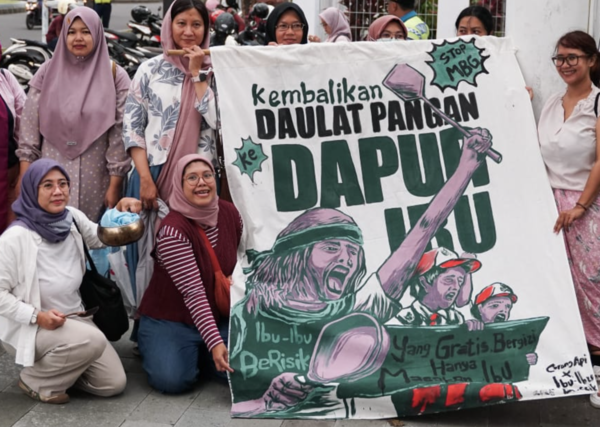
Mothers protesting against the MBG programme in Yogyakarta, Indonesia, 18 October 2025. (Ibu Berisik)
January 2026 marks one year since the launch of Makanan Bergizi Gratis (MBG, or Free Nutritious Meals)-- a programme that provides children with free meals, mainly through schools. It is one of the eight flagship initiatives of Prabowo Subianto's presidency in Indonesia. MBG had been a central programme during the presidential campaign and has remained prominent since Prabowo took office. The programme is framed as a major policy effort to address Indonesia’s nutrition problems. It is also promoted as a programme that can boost small and medium enterprises and generate employment opportunities, as it is run by people, for people.
However, the implementation of MBG has raised serious concerns. Rather than strengthening local food systems and improving nutritional outcomes, the programme is leading to corruption, oligarchic control, and corporatisation in Indonesia's food and agriculture sector. Reports from various regions show that meals provided under MBG are often not sufficiently nutritious, with the inclusion of packaged and ultra-processed foods, and can be unsafe, as there have already been over 20,000 cases of food poisoning incidents reported across the country.
There are increasing concerns about the governance and oversight of this massive programme. In its first year, the MBG programme had a 71 trillion rupiah (US$ 4.2 billion) budget-- about 10 percent of Indonesia's national education budget. When food procurement and distribution are centralised and involve large financial flows, the risks of mismanagement and rent-seeking inevitably increase. So far, the programme hasn’t done much to empower local farmers, small food producers, and community kitchens. Instead, it risks consolidating supply chains in the hands of a few large vendors and corporate actors.
The centralised and top-down implementation of MBG has excluded local communities, and in many cases, weakened the role of families and communities as the core pillars of food security. Instead of building on existing local food systems and community participation, as previous governments attempted to do, the programme has placed control in the hands of MBG authorities and large institutional actors, such as Badan Gizi National (BGN/ National Board of Nutrition) and even the police and military, which control MBG distributions. In addition, the implementation of MBG appears to have boosted the involvement of large foreign corporate actors, such as Danone, Nestlé and Frisian Flag (Friesland Campina) as suppliers within the MBG system.
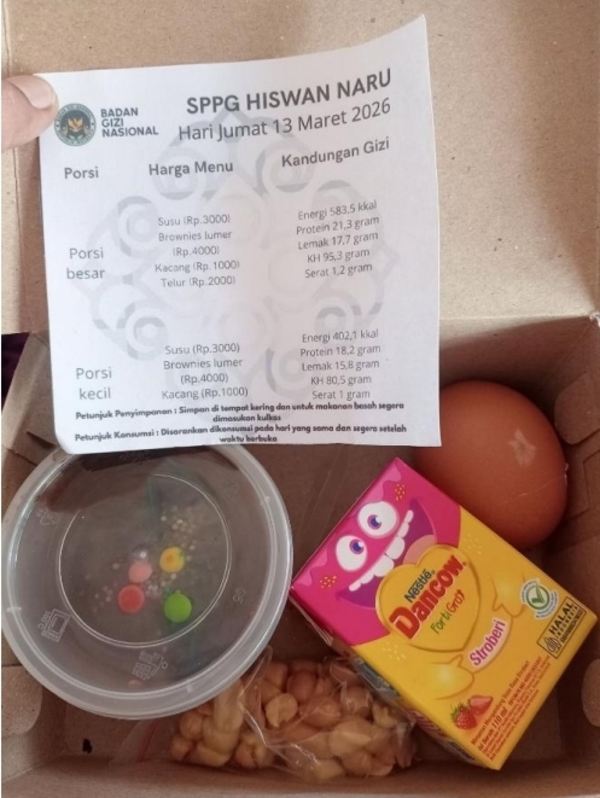 "Free nutritious meal menu today, 13 March 2026 at Tente 02 elementary school (West Nusa Tenggara)". IG@astutiningsieh Concerns have been raised about the extent to which MBG kitchens are reportedly operated or controlled by actors closely linked to political networks. These include political parties that supported Prabowo's presidential campaign, local elites and officials, and even institutions such as the military and police. This arrangement risks reinforcing existing systems of corruption, political patronage and oligarchic control, where access to public resources becomes tied to political loyalty and institutional power. In some cases, MBG may even disrupt existing community-based food distribution systems that have long sustained local markets and livelihoods in Indonesia.
Originally announced as a social welfare initiative, MBG has increasingly become a site of political and economic contestation, fuelling the growth of "new food oligarchies" that displace families, communities, and local food systems from control over nutrition.
-by Nurul Aini (Nurul is a sociologist at Gadjah Mada University and member of the Yogyakarta Mothers' Alliance which has been holding regular protests against MBG in the streets of Yogyakarta, Indonesia since September 2025.)
India’s nutritional security is possible through a decentralised and diverse food system
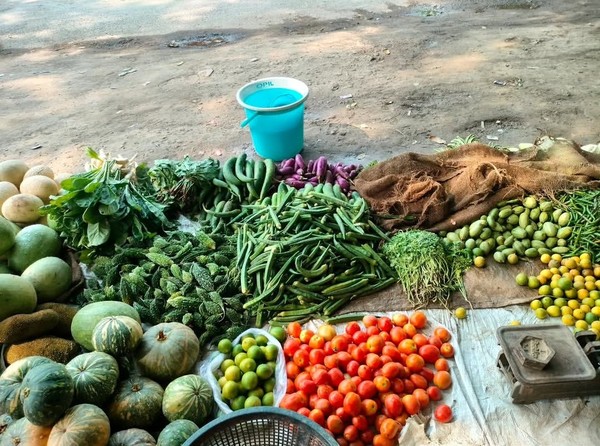
Vegetable Market in one village of Azamgarh, Uttar Pradesh (Raj Shekhar)
One way this problem can be addressed is by decentralising food procurement to the local level. Not only can this enhance the nutritional quality of food security programs but it can make a positive impact on local economies.
Lack of nutrition on the plate
In the early years of independence, India struggled with a food crisis due to poor production and was forced to import food grains to feed millions of Indians. In the 1960s, India went ahead to strengthen its food security through the Green Revolution to achieve self-sufficiency. The Food Corporation of India (FCI) was set up to procure grains at a preannounced minimum support price to ensure fair returns to farmers, maintain buffer stocks and distribute food grains to those most in need through a public food distribution system.
In 2013, with the people’s struggle and demand to ensure the right to food for all, the National Food Security Act came into existence, which ensured a legal guarantee and government accountability for the right to food. Since this Act was established, India has been able to create a robust procurement system, with a large stock of foods produced every year. The country’s self-sufficiency, however, is limited to only cereals, especially rice and wheat, which do not meet the nutritional requirements for a healthy life. Given the critical role that the public food distribution system plays in a context where a significant part of the population is unable to access a diversified diet by their own means, this is a major missed opportunity – with implications for population health and wellbeing, livelihoods for food producers, and local economies. Essential food items such as pulses, oilseeds and vegetables are still out of the government’s priorities to procure them at the public level and therefore not included in the public food distribution system.
By limiting procurement to a narrow range of cereals, the system has contributed to a poor nutritional intake for the majority of Indians. Oilseeds and pulses are crucial crops that ensure nutrition and are part of the daily consumption of millions of Indians. Despite this, India remains import-dependent for both commodities, making it highly volatile in terms of prices. As of 2024, India imports about 60 percent of its edible oil and around 10 percent of domestically consumed pulses. The FAO State of Food Security and Nutrition in the World 2025 reported that 55.6% of the Indian population cannot afford a healthy diet.
Disregard of Local Food Systems
High costs of production are another factor undermining diversity in local food systems. Vegetable farming was profitable for small farmers but the recent increase in production costs means that farmers are now suffering net losses. The government used to subsidise or even provide seeds and fertilisers for free to farmers to keep costs down, but these supports, as well as public investment in rural infrastructure, have been scaled back, leaving farmers at the mercy of markets to meet their input needs.
To address farmers’ labour and cost of production, it is important to ensure a minimum support price on vegetables too. Setting the price of vegetables in a way that considers actual costs is essential to ensure net earnings and to do justice to the labour of the farming family. In the state of Kerala, the state government became the first to enact a minimum support price on vegetables in 2020 when it fixed a floor price on 16 items, covering vegetables, fruits and tubers. Such encouragement to crop diversification contributes to nutrition and biodiversity, and helps make India self-sufficient in proteins and edible oils again.
Diversified, decentralised public food programmes can boost procurement and nutrition
India’s food security safety net under the National Food Security Act plays an important role in addressing hunger and malnutrition. However, it lacks a food systems approach that considers all the stages from production to consumption in ensuring overall access, availability and affordability to diverse foods. In this context, certain issues related to agriculture need specific attention. A decentralisation of the food security system with decentralised procurement at the local level, would not only reduce the cost of foodgrains transportation but would also put nutrition in the food basket.
The state of Tamil Nadu’s breakfast scheme is a good example of a localised nutritious food programme where local food prepared by women-led self-help groups contributes significantly towards the health and nutrition of school children. The Tamil Nadu State Planning Commission reported that the breakfast scheme led to a 63.2 percent decline in hospital admissions among primary class children in government schools and a 70.6 percent reduction in serious illnesses in 2024.
It is crucial to invest in building a decentralised, diverse and equitable food system while putting in place robust social protection measures. A localised food system approach in public procurement not only supports a diversified and nutrition-rich diet for society but also contributes to the improvement of livelihoods and local economies. This will take us forward in building resilience against future crises while ensuring food security for all.
-by Raj Shekhar (Co-Convener, Right to Food Campaign, India and Researcher at Centre for Financial Accountability)
Public procurement: a missed opportunity for street vendors in the informal economy?
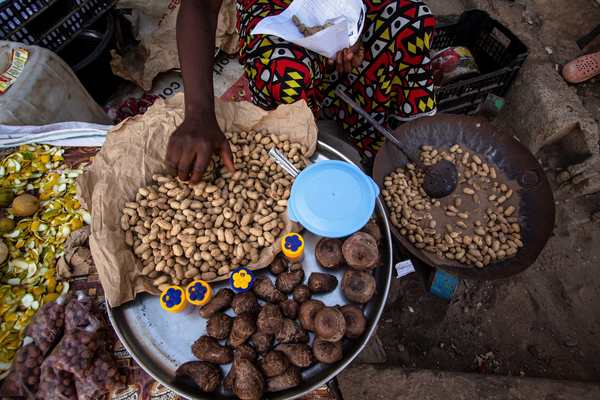
Food vendor in the Ouakam, Dakar, Senegal (Marta Moreiras, 2022)
For decades, municipal authorities have viewed street food vendors either as a source of tax revenue or as a public order problem to be managed - usually through violence, eviction or confiscation of goods. However, a growing body of evidence suggests that these vendors can—and should—be seen as active partners for public institutions. By integrating street food vendors into public procurement systems, cities can leverage the informal economy into opportunities for more sustainable food systems.
A primary benefit of including street vendors in procurement is the creation of shorter, more resilient food networks. In Kenya, for example, the Access to Government Procurement Opportunities (AGPO) programme reserves 30% of contracts for marginalised groups, creating a "pull factor" where the public market incentivises street vendors and small scale traders to voluntarily enter the formal economy by gaining a documented legal status.
Furthermore, sourcing directly from local communities ensures that public funds circulate within the local economy. Decentralised networks of small-scale vendors are often more adaptable to supply shocks than centralised, industrial catering firms; they also better support community access to quality, culturally relevant food.
The model is not without challenges. Public food programmes often require extensive paperwork, compliance procedures, and digital reporting that can exclude the people that the programmes aim to support. Many small-scale vendors lack the administrative capacity, digital literacy, access to internet or financial resources to navigate complex tendering processes. There can also be issues with corruption. For instance, while the Kenyan programme has a digital component to mitigate corruption, there are loopholes where individuals, including government officials, register small businesses in the programme using fraudulent identities from unsuspecting people to win tenders, sidelining genuine applicants.
As an alliance of workers in the informal economy, we believe that formalisation is most effective when presented as a tool for inclusion and economic growth rather than a punitive measure. By providing a clear path to government contracts, street vendors can be reimagined as professional service providers. This shift can improve their livelihoods and integrate them into the urban infrastructure. Public procurement can be a catalyst for social and economic integration. For food vendors, it means moving from the margins to the centre of city systems. For the public, it means a more democratic and localised food system. Supporting the informal economy through inclusive procurement doesn't “clean up” the streets in the top-down, neoliberal sense, but helps build equitable cities.
-by StreetNet International
News brief
Md Zakariya Khan, Fortune India
Rising liquified gas prices and supply shortages from the US-Israel war on Iran are quickly pushing up food costs across India, affecting both street food vendors and restaurants. According to a survey by LocalCircles reported on March 17, “Over 1 in 2 consumers surveyed say both street food vendors and restaurants have increased food prices in the last one week.” The findings are based on responses from more than 38,000 consumers across 309 districts.
Marc Wegerif, The Conversation
The Johannesburg fresh produce market is the primary source for the vast informal retail sector, with over 10,000 registered regular buyers, including street vendors, hawkers and small-scale retailers. This forms the backbone of fresh produce access in low income neighbourhoods. Yet, the market is under threat from a confluence of challenges, such as supermarket competition, decaying infrastructure, and the prolonged dominance of white, male market agents.
Raj Patel, Canadian Centre for Policy Alternatives
Canada's oligopolistic food retail system, with five large chains dominating 80% of the market, has sparked widespread skepticism, prompting the idea to establish government-run low-cost grocery stores. Experience in the United States and Mexico has shown that public grocery stores could work at scale and independently of the big retailers' distribution systems. It can improve food affordability, boost local food production, and create well-paying jobs.
Liengu Etaka Esong, Cameroon Tribune
The second Green Market initiative, organised by the National Synergy of Peasants and Villagers of Cameroon (SYNARPACAM) was held in Mbonjo, in December 2025. Farmers from the river islands to the creeks of Mbonjo have long suffered from high transportation costs and middlemen's poor prices. The Green Market provided transportation, storage facilities, training, and finance to help rural women find reliable buyers for their ecological produce and sell it at fair prices.
Gaea Cabico, Sentiment
Food waste accounts for 8–10% of total global emissions. In the United States, the majority of surplus food ends up in landfills or incinerators, releasing methane, a strong greenhouse gas. Starting July 1, 2026, California will enact the country's first legislation prohibiting the use of "sell by" dates for food products to avoid consumers mistaking them for expiration dates, and requiring commercial businesses to donate edible food that would otherwise be discarded.
Jordan Valinsky, CNN Business
Amazon is closing its Amazon Fresh and Amazon Go stores, with some locations to be converted into Whole Foods Market stores. The move marks the e-commerce giant’s latest retreat from its brick-and-mortar retail efforts.