May 2025
What is UPOV?
For thousands of years, smallholder farmers have cultivated, saved, shared and nurtured their indigenous seeds. In that process, they have created an incredible wealth of biodiversity: different plant varieties adapted to specific soils, climate conditions, social preferences, cultural needs, etc. This diversity allows farmers to serve local needs and spread out risks. But in the 20th century, in the industrialized countries, plant breeding became a separate activity from farming itself. In Europe, breeders wanted ownership rights over their varieties, to prevent farmers from freely copying them. In 1961, they created the International Union for the Protection of New Varieties of Plants (UPOV) with its own set of harmonised rules called plant breeders’ rights. Under these rules, seed companies can legally prevent farmers from freely saving and reusing their seeds for a period of around 25 years. This is a monopoly right.
For seeds to be protected under UPOV, they have to be genetically uniform and stable. In this way, UPOV is meant to serve the industrial food system, which relies on standardised crops grown as monocultures. Because they lack diversity, these crops require agrochemicals like fertilisers, herbicides and pesticides to grow well. This puts small scale farmers, the environment and people’s health at risk.
Who pushes UPOV?
For many years, UPOV’s membership was limited to industrialised countries. But since the 1990s, these governments been forcing countries of the global South to join UPOV as well. Their goal is to expand the global commercial seed market, dominated by their own corporations. They do this through trade agreements, whether at the World Trade Organisation (WTO) or under bilateral free trade negotiations (FTAs). These deals require countries to provide either some form of plant variety protection (WTO) or UPOV specifically (FTAs). Today, more than 70 countries are members of UPOV.
What are the impacts?
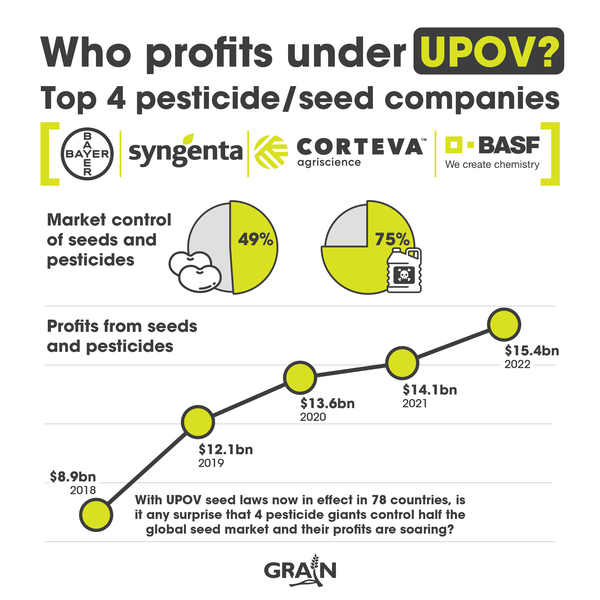
UPOV and other seed laws promote highly uniform commercial seeds, under the guise of them being more productive than farmers’ seeds. Once adopted, they replace farmers’ varieties. This makes farmers dependent on seed companies, to whom they have to pay royalty fees due to so called "breeder's rights". And UPOV makes it illegal for farmers to freely save these seeds from their harvest – they can even go to jail if they save and re-use seeds. Thanks to UPOV, the world's large seed companies have consolidated their control over several key seeds for the world's food and have made huge profits from it.
As a result, biodiversity is lost and farmers become hostage to seed corporations. Today, just four companies control 60% of the global market. This is not a good direction, especially if we want to build food sovereignty and agroecology.
What is the StopUPOV campaign?
On 2 December 2021, to mark six decades of UPOV's seed privatisation, hundreds of farmers' groups and civil society organisations around the world came together to oppose the corporate hijack of seed systems and demand the dismantling of UPOV. The goal is to push back against the spread of the corporate seed system and create or protect space for farmers’ seeds, the foundation of food sovereignty. As such, the campaign aims to stop the commodification of seeds worldwide, and keep biodiversity in the hands of rural communities, as a commons.
It does so by:
- Offering a platform for groups around the world resisting UPOV and other types of seed laws to work together
- Providing a space to share information in different languages
- Coordinating a common day of action every 2 December, with collectively planned events
Some 400 groups and individuals are participating in the campaign. Over the years, actions have been led to support resistance in a range of countries. Examples include:
- Open letters to stop the governments of Benin and Zambia from joining UPOV
- Support to groups in Argentina, the Philippines, Honduras and Guatemala resisting their countries’ plans to join UPOV 1991
- Helping groups in the UK, Switzerland and Indonesia get UPOV out of their governments’ free trade negotiations
- Fostering research and information work to better understand UPOV and its impact on farmers’ seeds.
- Developing and sharing popular campaign materials like animation videos, workshops and artwork.
Currently, groups are discussing whether to organise a Permanent People’s Tribunal on UPOV and the privatisation of seeds.
How to join?
- Subscribing to the central email list where we plan joint activities: stopupov-join@ourlists.org
- Join the public Stop UPOV Facebook group, where members share updates about what is happening in their different countries: https://web.facebook.com/groups/904253430508472
- Take part in the global day of action against UPOV by organising an event in your own location on 2 December!
For further information about the global campaign please contact: Kartini Samon, GRAIN: [email protected]
Photo: Members of the Kyamaleera Woman’s Handicraft Association. Credit: ©2016CIAT/GeorginaSmith